In storytelling, props are usually just that—passive objects that fill a scene or serve a simple function. But some objects transcend their roles, becoming active participants in the narrative. Few props achieve this with the psychological depth and terrifying impact of the mirror. When a reflection stops mimicking and starts acting, it evolves from a simple piece of glass into a character in its own right, often embodying a story’s deepest conflicts and fears.
This article explores how mirrors are transformed into active characters in horror and psychological thrillers. We will examine how storytellers give reflections a life of their own, turning them into antagonists, symbols of inner turmoil, or malevolent entities. By looking at key examples from film and literature, we can understand the profound symbolic power of a mirror that refuses to be just a reflection.
From Object to Antagonist: The Malevolent Mirror
Advertisement


The most direct way a mirror becomes a character is when it is presented as a conscious, malevolent force. In these stories, the mirror is the primary antagonist, an entity with its own motives, intelligence, and a desire to cause harm. This transforms the narrative from a simple haunting into a battle against a sentient object.
A prime example is the Lasser Glass from Mike Flanagan’s film Oculus. This antique mirror is not merely a haunted object; it is a parasitic predator. The mirror actively defends itself, feeds on the life force of those around it, and manipulates its victims’ perception of reality. It projects complex hallucinations, blurs the line between past and present, and turns family members against one another. The Lasser Glass is a character with a clear objective: survival and propagation. The protagonists are not fighting a ghost; they are fighting the mirror itself.
Similarly, the film Mirrors presents reflective surfaces as the vessels for a demonic entity. The reflections don’t just show scary images; they can physically harm people. A character’s reflection can inflict wounds upon itself, causing the real person to suffer the same fate. Here, the reflection acts as the antagonist’s agent, a puppet master pulling the strings of its victim’s body. The mirror becomes a thinking, acting villain that uses a person’s own image as a weapon against them.
The Double: When the Reflection Embodies Inner Conflict
Advertisement


In more psychological storytelling, a reflection taking on a life of its own serves as a powerful metaphor for a character’s internal struggle. The independent reflection becomes a doppelgänger, a visual manifestation of a repressed or emerging part of the character’s psyche. This “mirror character” represents the dark side, the inner monster, or the fractured identity battling for control.
A Symbol of Fractured Identity
Darren Aronofsky’s Black Swan is a masterclass in using the mirror as a character to represent a fracturing mind. As ballerina Nina Sayers strives for perfection, her reflection begins to move independently. It smirks when she is still, continues dancing after she has stopped, and eventually becomes a menacing, dark version of herself. This reflected double is the embodiment of the “Black Swan”—the sensual, confident, and dangerous persona she must embrace to succeed. The reflection is not a ghost; it is a character representing her ambition and paranoia, an externalization of her internal battle.
The Externalized Conscience or Rival
In literature, this trope is just as powerful. Edgar Allan Poe’s short story “William Wilson” features a protagonist who is tormented his entire life by a rival who shares his name, appearance, and birthday. This doppelgänger, who can be seen as a kind of living reflection, consistently thwarts the protagonist’s malicious schemes, acting as his external conscience. When the protagonist finally confronts and stabs his double, he discovers he has stabbed himself while looking in a mirror. The double was a separate character whose purpose was inextricably linked to the protagonist’s own soul.
Fyodor Dostoevsky’s The Double also explores this theme, with a man whose life is systematically dismantled by his exact look-alike. This doppelgänger is everything the protagonist is not—charming, successful, and ruthless. The reflection, given a physical form, becomes a rival who ultimately drives the main character to madness.
The Trickster and Unreliable Narrator
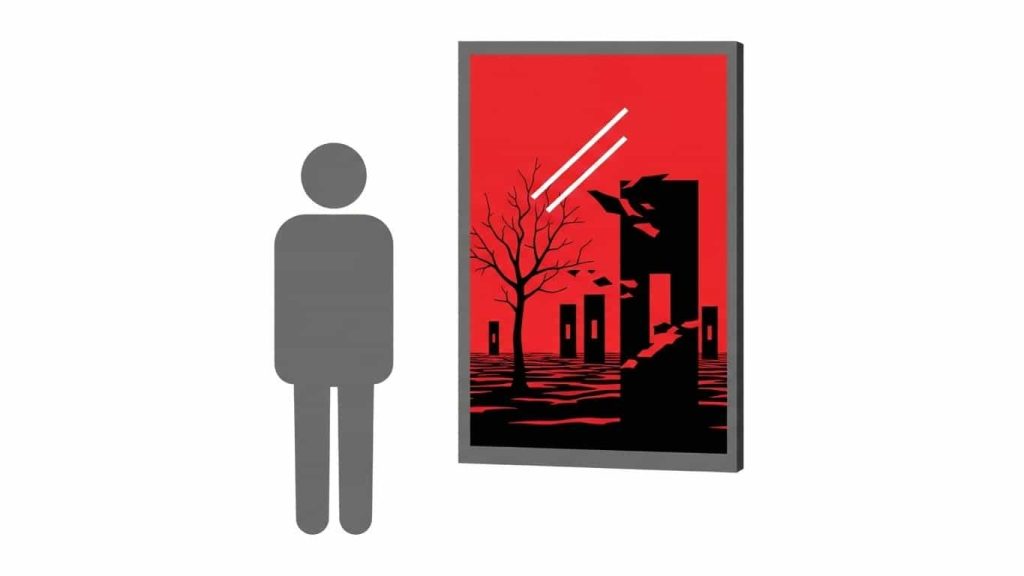
Sometimes, the mirror as a character is not purely evil or a symbol of inner conflict but acts as a trickster. It becomes an unreliable narrator, deliberately showing false images to deceive and confuse. This type of mirror character plays with perception, making both the characters in the story and the audience question what is real.
In stories featuring fae or other trickster spirits, mirrors are often depicted as tools of illusion. A reflection might show a beautiful landscape to lure someone into a trap or present a distorted image to lead them astray. The mirror’s goal is not necessarily to kill but to sow chaos and confusion for its own amusement.
This concept makes the mirror a character that cannot be trusted. Its actions are unpredictable, and its motives are unclear. This creates a deep sense of unease, as the fundamental rule of a reflection—that it shows the truth—is broken. Every glance into the glass becomes a gamble, forcing characters to navigate a world where their own eyes can deceive them.
The Gatekeeper: A Character that Guards a Threshold
Advertisement



In many fantasy and horror narratives, mirrors function as portals to other dimensions. When these portals are sentient, the mirror itself becomes a gatekeeper—a character whose role is to guard the threshold. This character may be a neutral entity, a benevolent guide, or a formidable obstacle.
Jean Cocteau’s Orpheus portrays mirrors as liquid gateways to the Underworld, and the beings that control them act as gatekeepers. The decision to allow someone to pass through is an active choice made by the forces that govern the mirror. Lewis Carroll’s Through the Looking-Glass also personifies the mirror world, giving it its own logic and inhabitants. The mirror is not just a passive door but the entrance to a kingdom with its own rules, and crossing it means subjecting oneself to that character’s domain.
This portrayal gives the mirror a sense of immense power and agency. It is a character that holds the key to another reality, and interacting with it requires respect, negotiation, or a direct challenge.
A Reflection of Character-Driven Storytelling
When a mirror transcends its status as a mere object and becomes a character, it enriches the story in profound ways. It allows for a visual and visceral exploration of complex psychological themes like identity, duality, and the nature of reality. The mirror as an antagonist creates a unique and formidable threat, while the reflection as a doppelgänger provides a powerful metaphor for internal struggle.
These sentient reflections are compelling because they take a familiar, trusted concept—that a mirror shows the truth—and corrupt it. They force us to confront the unsettling idea that our own image could have a will of its own, that a silent, other world exists just beyond the glass, and that its inhabitants might not be friendly. By giving reflections a life of their own, storytellers have created some of the most memorable and terrifying characters in fiction, proving that sometimes the greatest horror lies in a distorted version of ourselves.