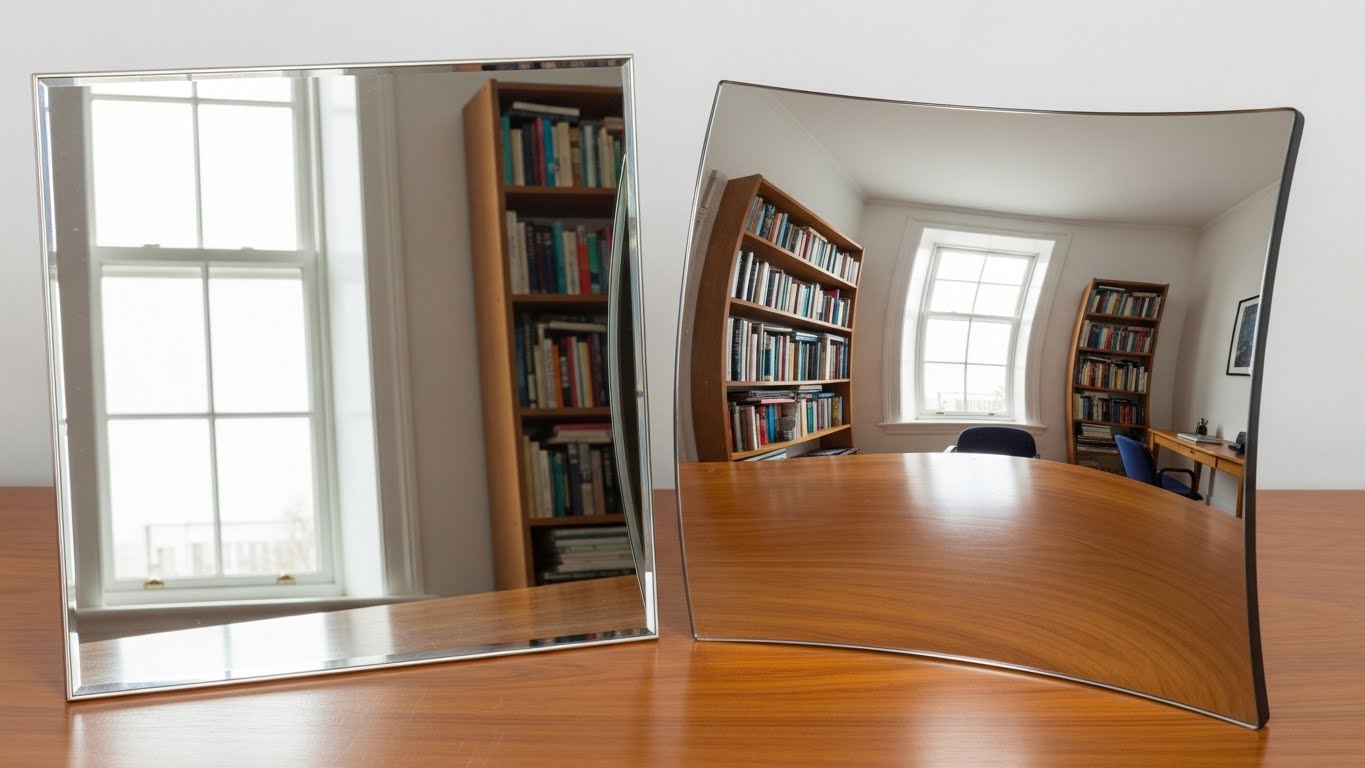
Mirrors are a part of our daily routine, from the one in your bathroom to the side mirror on your car. We often see them as simple tools for checking our appearance. However, the shape of a mirror does more than just fit a frame; it fundamentally changes how we see the world through it. The difference between a flat surface and a curved one is the key to a wide range of optical effects.
This article explores the fascinating comparison between flat and curved mirrors. We will dive into how their distinct shapes influence light, create different types of images, and serve unique purposes in our everyday lives. Understanding these differences unlocks a deeper appreciation for the reflection science that powers everything from makeup mirrors to advanced telescopes.
The Foundation: How All Mirrors Reflect Light
Advertisement


Before we compare shapes, it’s important to remember the basic principle that unites all mirrors: the law of reflection. This rule states that when a ray of light hits a mirror’s surface, the angle at which it arrives (the angle of incidence) is equal to the angle at which it bounces off (the angle of reflection).
Imagine throwing a ball against a wall—it bounces off predictably. Light behaves similarly. The key difference between flat and curved mirrors isn’t if they reflect light, but how they direct that reflected light. The geometry of the mirror’s surface dictates whether light rays stay parallel, come together, or spread apart.
The Standard: Plane Mirrors
The most common type of mirror is the plane mirror, which has a perfectly flat reflective surface. This is the mirror you likely have in your bedroom or bathroom. Its behavior is straightforward and predictable, which is why it’s our standard for comparison.
Image Properties of a Plane Mirror
When you look into a flat mirror, the image you see has specific characteristics:
- Virtual: The image appears to be behind the mirror. You can’t project it onto a screen because the light rays don’t actually converge there. Your brain simply traces the diverging rays back to a point behind the glass.
- Upright: The image is oriented the same way as the object. Your head is still at the top, and your feet are at the bottom.
- Same Size: The image is the same size as the actual object. There is no magnification or reduction.
- Laterally Inverted: This is the classic “mirror image” effect. Your right hand appears as the left hand of your reflection.
Because they provide a true-to-size, undistorted view, plane mirrors are ideal for tasks where accuracy is key.
Common Uses for Flat Mirrors
- Personal grooming mirrors (bathrooms, dressing rooms)
- Home decor to create a sense of space
- Periscopes and kaleidoscopes
- Signaling devices (heliographs)
The Convergers: Concave Mirrors
Advertisement


Now, let’s add a curve. Concave mirrors are curved inward, like the inside of a spoon. This shape causes parallel light rays that strike the mirror to converge, or come together, at a single point known as the focal point. This ability to focus light gives concave mirrors unique and powerful properties.
Image Properties of a Concave Mirror
The image formed by a concave mirror depends entirely on the object’s distance from it.
- Object Far Away (Beyond the Focal Point): When an object is placed far from the mirror, the reflected rays converge to form a real, inverted image. “Real” means the image can be projected onto a surface, like a movie screen. The image will also be upside down. Depending on the exact position, the image can be smaller or larger than the object.
- Object Close Up (Inside the Focal Point): When an object is placed very close to the mirror, the reflected rays diverge. Your brain traces them back to a point behind the mirror, creating a virtual, upright, and magnified image.
This magnifying effect is the most common reason people use concave mirrors in their daily lives.
Common Uses for Concave Mirrors
- Magnifying Mirrors: Shaving mirrors and makeup mirrors use this principle to make your face appear larger for easier grooming.
- Car Headlights: A light bulb placed at the focal point of a concave reflector projects a strong, parallel beam of light forward.
- Reflecting Telescopes: Large concave mirrors are used to gather and focus faint light from distant stars and galaxies, allowing astronomers to see deep into space.
- Solar Furnaces: Rows of concave mirrors can focus sunlight onto a single point to generate intense heat.
The Divergers: Convex Mirrors
Advertisement



If you flip the spoon over, you have a convex mirror. These mirrors curve outward, causing parallel light rays to diverge, or spread apart, after they reflect. Because the reflected rays spread out and never meet, convex mirrors can only form one type of image.
Image Properties of a Convex Mirror
Regardless of the object’s distance, a convex mirror always produces an image with the same characteristics:
- Virtual: The image appears behind the mirror.
- Upright: The image is always right-side up.
- Smaller: The image is always smaller than the actual object.
The most significant advantage of this shape is its ability to provide a wider field of view. By shrinking the reflection, a convex mirror can capture a much larger area than a flat mirror of the same size.
Common Uses for Convex Mirrors
- Passenger-Side Car Mirrors: These mirrors give drivers a wider view of the road and traffic next to them. This is why they are often inscribed with the warning, “Objects in mirror are closer than they appear”—the shrinking effect can be deceptive.
- Security Mirrors: Placed in the corners of stores or at blind intersections, they allow people to see around corners and monitor a large area at once.
- Hallway and Parking Garage Safety: They are often placed at sharp turns to prevent collisions.
- ATM Security: A small convex mirror is often placed on ATMs so you can see if someone is behind you.
A Clearer Reflection on Mirror Shapes
Advertisement


The shape of a mirror is not an arbitrary design choice; it is a carefully engineered feature that controls the path of light. Flat mirrors provide a faithful, one-to-one reflection perfect for daily tasks requiring accuracy. Curved mirrors, on the other hand, manipulate light for specific purposes. Concave mirrors focus light to magnify or project images, while convex mirrors spread light to offer a wide-angle view for safety and security.
The next time you see your reflection, whether it’s life-sized in your bathroom, magnified for a closer look, or shrunken in your car’s side mirror, you can appreciate the powerful role that geometry plays in shaping your perception of the world.