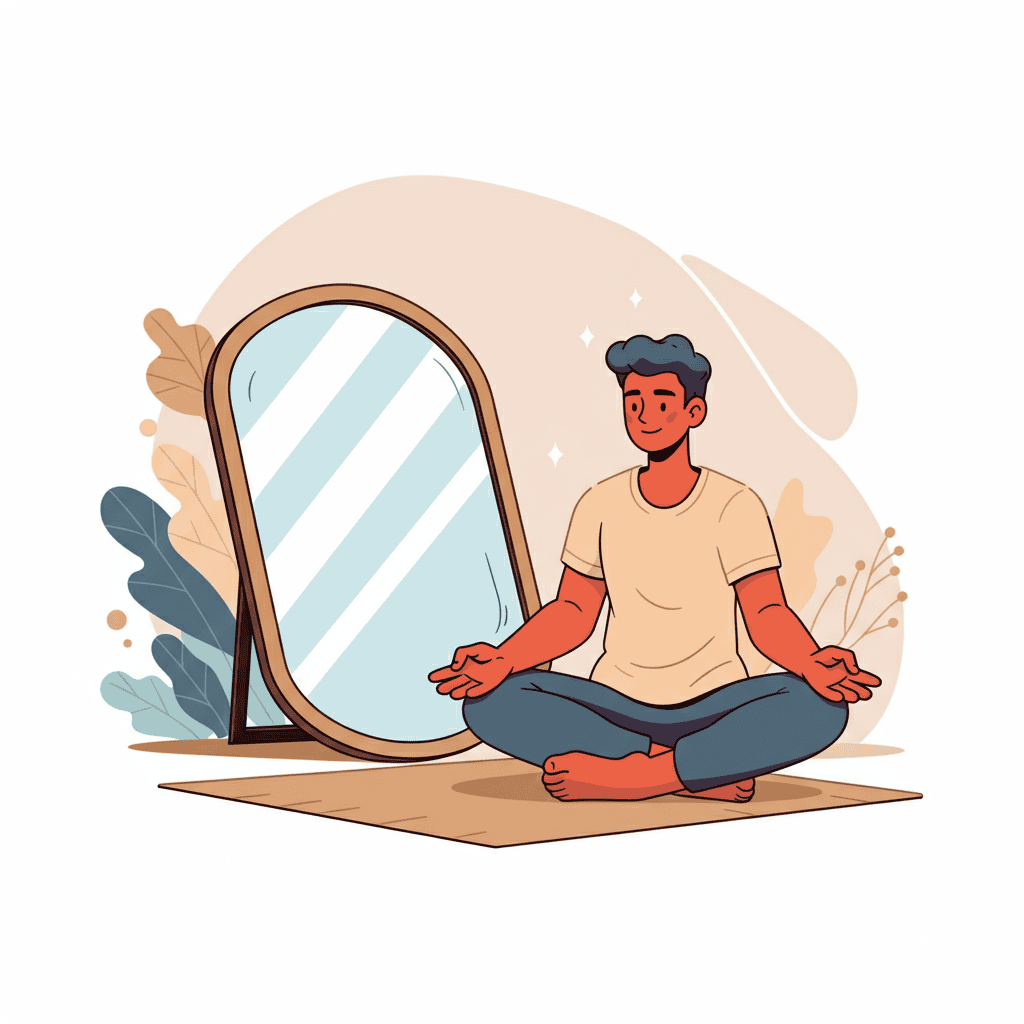
Mirrors are common objects, used for quick, practical checks of our appearance. But what if that reflective surface could offer more than just a superficial glance? The practice of mirror gazing transforms this simple act into a profound tool for emotional healing and self-discovery.
This guide will answer the fundamental question: what is mirror gazing? We will explore how this intentional practice works, its scientific basis, and the steps you can take to use it. We will also address important considerations, such as whether mirror gazing can be dangerous and distinguish it from related but different concepts like the mirror gazing ball.
Understanding Mirror Gazing Therapy
At its core, mirror gazing therapy is a meditative practice. It involves looking into your own eyes in a mirror for a sustained period. The objective is not to critique your appearance but to observe your reflection without judgment. This intentional focus fosters a deep connection with yourself, allowing thoughts and emotions to surface in a safe, observant space.
It’s a practice of presence. Instead of seeing a collection of features to be fixed, you begin to see the person looking back at you. This simple shift is the foundation of its therapeutic power.
A Brief History of Reflection
The modern term “Mirror Gazing Therapy” is recent, but the practice has ancient roots. Spiritual traditions worldwide used reflective surfaces, like still water or polished metal, for contemplation and insight. These practices were not about vanity but about looking beyond the physical to understand the self.
In Western psychology, 20th-century experiments explored how prolonged self-reflection impacts our sense of identity. This convergence of ancient wisdom and modern inquiry has shaped the practice of mirror gazing as we know it today.
Distinguishing from Other Practices
It’s important to clarify that this therapeutic technique is different from scrying with a mirror gazing ball or a mirrored gazing ball. These tools, often a dark mirror or crystal sphere, have historical roots in divination and are used to perceive images or messages. Likewise, a mirror gazing globe, a common garden ornament, is for aesthetic reflection of the surrounding environment. The practice discussed here is focused solely on self-reflection using a standard mirror.
The Science Behind Mirror Gazing
The transformative effects of mirror gazing are supported by principles of psychology and neuroscience. When you engage in focused self-reflection, you activate powerful processes in your brain.
The Psychology of Self-Empathy
Our self-esteem is directly linked to our self-perception. The practice works with this link through “mirror neurons.” These brain cells are the foundation of empathy; they fire when we perform an action and when we see someone else do it. By directing your gaze inward with kindness, you can turn this empathetic response toward yourself. This fosters self-compassion, a crucial element for emotional healing.
Insights from Neuroscience
Brain imaging studies show that self-reflection activates the prefrontal cortex, the area responsible for self-awareness and conscious thought. Consistent mirror gazing can also help calm the amygdala, the brain’s fear and stress center. This dual action helps you process self-related thoughts more mindfully and less reactively, which can reduce feelings of anxiety. Sustained gazing can sometimes lead to perceptual shifts, which some psychologists interpret as the mind deconstructing rigid self-concepts to allow for healthier ones to form.
How to Practice Mirror Gazing Safely
Starting a mirror gazing practice is simple. The most important element is creating a safe and supportive environment for genuine self-exploration.
A Step-by-Step Guide
- Create Your Space: Find a quiet, private area where you will not be disturbed. Dim lighting can help create a softer, less clinical atmosphere that encourages vulnerability.
- Set a Timer: Begin with short sessions. Five to ten minutes is a great starting point. If that feels too intense, two minutes is perfectly fine. You can gradually increase the time as you become more comfortable.
- Find Your Focus: Sit comfortably in front of a mirror. Relax your shoulders and take several deep, grounding breaths. Let your gaze rest on your own eyes. The goal is a soft, steady gaze, not an intense stare.
Techniques to Deepen Your Practice
- Silent Observation: Simply look at yourself. When thoughts or judgments arise, acknowledge them as passing events and gently return your focus to your reflection.
- Guided Affirmations: Speak positive affirmations to your reflection. Simple phrases like, “I am here with you,” or “I accept you,” can be very powerful when you see yourself receiving them.
- Emotional Exploration: Allow whatever emotions come up to be seen. If you feel sadness, let the tears flow. If you feel joy, let yourself smile. The mirror becomes a compassionate witness to your inner world.
- Journaling: After your session, write down your thoughts, feelings, and insights. This helps process the experience and track your journey over time.
Is Mirror Gazing Dangerous? Addressing the Concerns
A common question is whether mirror gazing is dangerous. The practice itself is safe, but it is powerful and can bring intense emotions to the surface. Discomfort, especially at the beginning, is normal as you confront your inner critic without distraction.
The risk lies in approaching the practice with judgment rather than compassionate curiosity. If you only use the time to list your flaws, you can reinforce a negative self-image. This is why the element of kindness is essential.
For individuals with a history of severe trauma or certain psychological conditions, the experience can be overwhelming. Some people may worry about a “mirror gazing disorder,” but this is not a recognized clinical diagnosis. However, obsessive or compulsive behaviors related to mirrors can be a symptom of conditions like Body Dysmorphic Disorder (BDD). MGT is a therapeutic tool, not a compulsion. If you are struggling with deep-seated issues, it is crucial to practice MGT with the guidance of a licensed therapist. If the experience ever feels unsafe, stop and ground yourself in your surroundings.
The Benefits of Consistent Practice
When approached with patience and kindness, mirror gazing offers numerous benefits for your well-being.
Emotional and Mental Rewards
The most significant outcome is often a profound increase in self-compassion. This practice helps heal the wounds of self-criticism. It also serves as a powerful grounding technique, reducing anxiety by anchoring you in the present moment. Over time, it enhances emotional intelligence as you become more attuned to your own inner states.
Long-Term Impact on Your Life
The cumulative effect of building a strong, compassionate relationship with yourself is resilience. This inner stability helps you navigate life’s challenges with greater confidence. Many people report a fundamental shift in their self-perception, moving from a critical to a more loving and accepting viewpoint.
Conclusion: Finding Peace in Your Reflection
Mirror gazing therapy offers a simple, direct pathway to self-discovery and healing. In a world that often encourages us to seek validation externally, this practice invites us to turn inward. It’s a journey of truly seeing yourself and finding acceptance in your own gaze.
We encourage you to experiment with this practice. Set aside a few minutes, find a mirror, and simply be present with the person looking back at you. That person is worthy of your time and your compassion.