
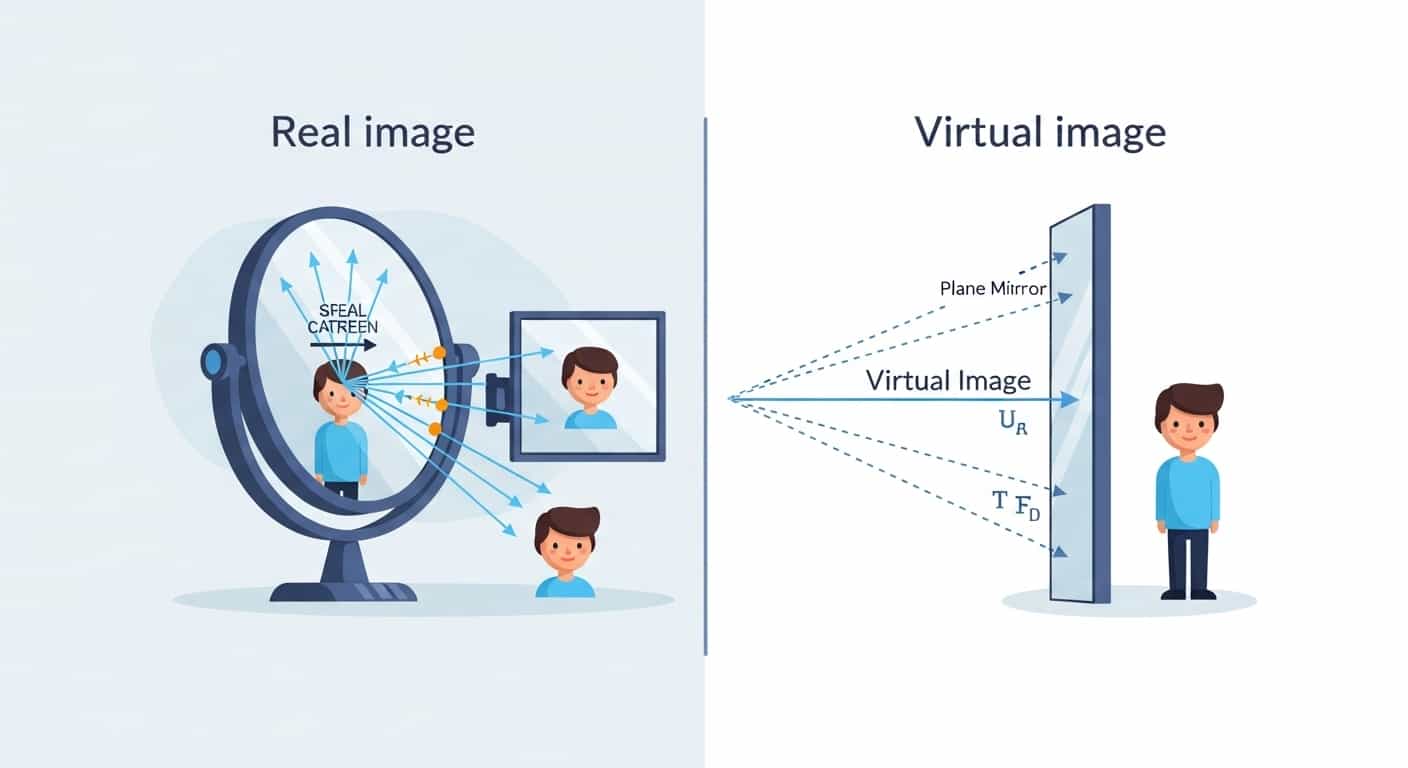
Quick Summary:
- Key Tip: Mirrors usually create virtual images, while projectors create real ones.
- Real Images: Formed by actual light convergence; can be projected; always inverted.
- Virtual Images: Formed by light appearing to diverge; cannot be projected; always upright.
Did you know that the image you see in a mirror is real or virtual? It’s a fascinating trick of light that our brains interpret as a perfect reflection. The answer, as you might suspect, is that it’s a virtual image. Understanding the difference between real and virtual images is fundamental not just in physics classrooms but also in our daily lives. This concept is the key behind how cameras, microscopes, movie projectors, and even our own eyes work.
This article will break down the science of image formation in optics. We will explore what are real and virtual images, how they are formed, and where you can find them all around you. By the end, you’ll see the world—and your reflection—in a whole new light, fully grasping the real image vs virtual image distinction.
What is an Image in Optics?
In the study of optics, an image is a visual representation of an object formed when light rays are manipulated by a mirror or lens. It is the specific point where light rays either actually converge (come together) or appear to diverge (spread apart) from. This basic definition is the foundation for understanding what makes an image real or virtual.
When light from an object strikes the surface of a mirror or passes through a lens, its path is altered. Mirrors reflect light, while lenses refract (bend) it. This redirection of light rays is what creates the image you perceive. Depending on how these rays behave after interacting with the optical device, the resulting image is classified as either real or virtual.
What Are Real Images?
A real image is formed when rays of light, after being reflected or refracted, actually intersect at a specific location. Think of it as a genuine collection point for light energy. This convergence is what gives real images their unique and useful properties.
Characteristics of Real Images:
- They are always inverted, producing a real and inverted image.
- They can be projected onto a screen. Because light rays physically meet, you can place a surface (like a screen or a wall) at that point to capture and display the image.
- They are formed by concave mirrors and convex lenses under specific conditions. So, when you ask, “concave mirror real or virtual?” the answer is that it depends on the object’s position; it can produce both, but it is the only type of mirror that can create a real image.
Examples of Real Images:
- Movie Projectors: The image formed by a projector is real or virtual? It is unequivocally real. A projector uses a convex lens to cast a large, inverted image onto the cinema screen.
- The Human Eye: The lens in your eye forms a small, inverted real image on your retina. Your brain then flips this image so you perceive the world as upright.
- Focusing Sunlight: Using a concave mirror to focus sunlight onto a single spot creates a real image of the sun. This spot is hot because all the light energy is physically concentrated there.
What Are Virtual Images?
So, what is a virtual image? A virtual image is formed when the reflected or refracted rays of light appear to diverge from a point behind the mirror or lens. Your brain traces these diverging rays back to an imaginary origin point, creating the illusion of an image. However, no light rays actually meet at this location.
Characteristics of Virtual Images:
- They are always upright. This answers the common query: are virtual images always upright? Yes, a key characteristic is that a virtual image is always upright; they have the same orientation as the object.
- They cannot be projected onto a screen. Since the light rays don’t actually converge, there is no image to capture.
- They are formed by plane mirrors, convex mirrors, and concave lenses. When someone asks, “convex mirror real or virtual?” the answer is that they exclusively produce virtual images.
Examples of Virtual Images:
- Your Bathroom Mirror: This is the definitive answer to “image in mirror is real or virtual?” It appears to be behind the glass, is upright, and is the same size as you.
- Security Mirrors: The wide-angle, convex mirrors in shops produce smaller, upright virtual images.
- A Magnifying Glass: When you look at small text, you are seeing a magnified, upright, virtual image.
Key Differences Between Real and Virtual Images
| Feature | Real Image | Virtual Image |
| Formation | Light rays actually meet at a point. | Light rays only appear to meet. |
| Orientation | Always inverted (upside-down). | Always upright. |
| Projection | Can be projected onto a screen. | Cannot be projected onto a screen. |
| Math Sign | Positive image distance ($d_i > 0$). | Negative image distance ($d_i < 0$). |
| Everyday Example | Cinema screen image. | Bathroom mirror reflection. |
Common Misconceptions About Images
- “Images in mirrors are real because we see them clearly.” False. The image is virtual. Your brain is simply “back-tracing” light rays to a point where they don’t actually exist.
- “All concave mirrors make real images.” Not always. If an object is placed closer than the focal point, a concave mirror produces a magnified, upright virtual image.
- “Virtual images don’t really exist.” They exist as perceptions. While they cannot be captured on a screen, they are visible to the eye because the eye’s lens refocuses the diverging rays.
Conclusion
The distinction between real and virtual images is central to the world of optics. Real images are formed where light rays truly converge, while virtual images are illusions created where rays appear to diverge from. To answer the core question simply: the main difference is that real rays of light form a real image, while only the projection of rays forms a virtual one.
From the cinema to your morning reflection, these principles shape our ability to see the world. Understanding these “tricks of light” allows us to build the technology that powers our modern lives.